

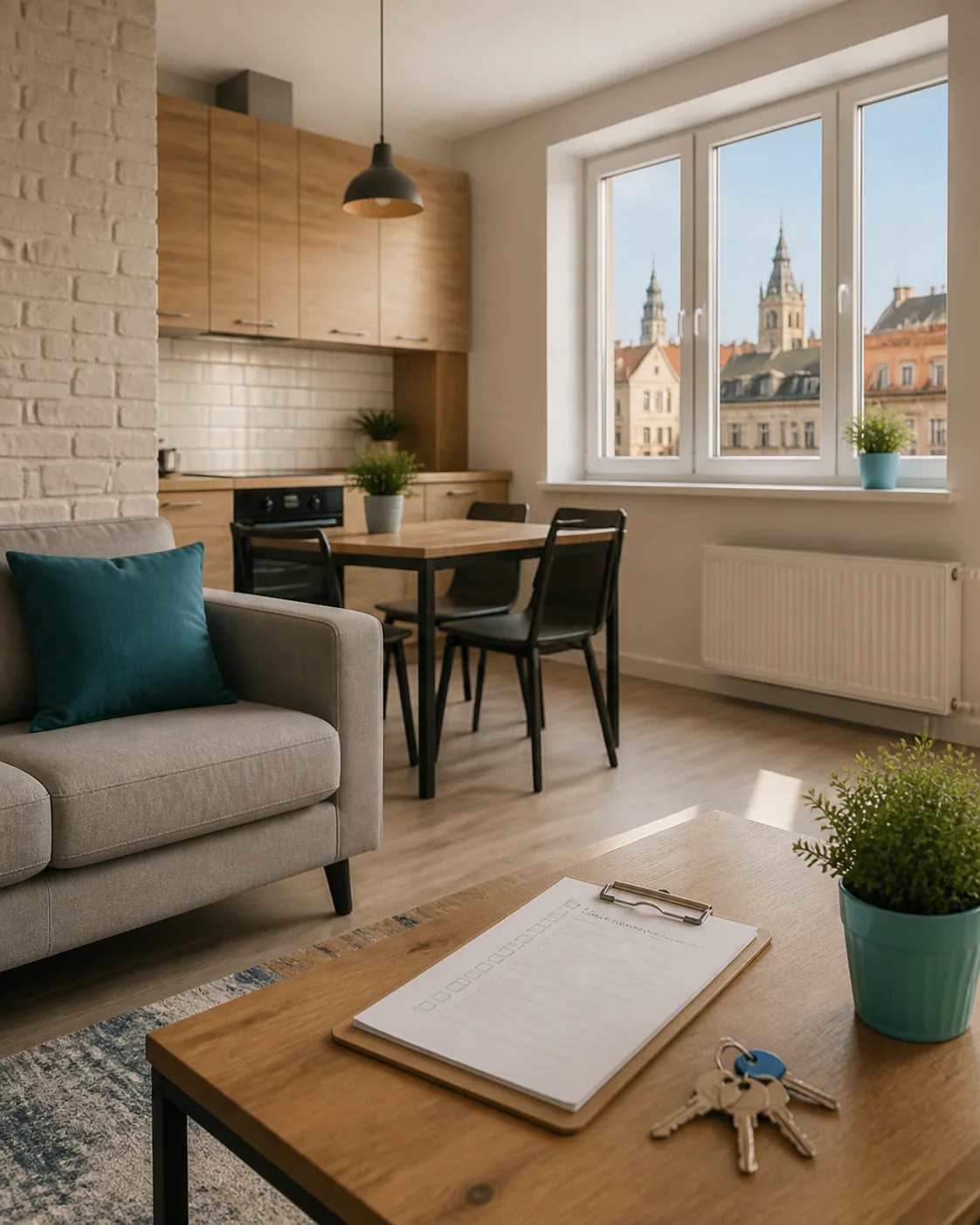
Safe renting is a sequence of decisions: search timing, the full budget, suitable areas, a clear tenant profile, verification of the other party, the agreement and evidence of the flat’s condition. This guide brings together the conclusions of 15 Roman & Masza articles, official rules and market data, with clear limits on what each source can prove.
When to start and how to plan the search
For a standard situation, allow about 3–5 weeks from active searching to signing and collecting the keys. With a pet, a narrow area, a tight budget, foreign income or a large household, a practical buffer of 5–8 weeks is safer. These are Roman & Masza planning guidelines, not a statistical market median.
Starting active viewings too early can also fail because many owners will not hold an empty flat without payment for several months. Prepare the budget, areas, documents and alerts in advance, then start viewings when you can make a decision.
Week 1: criteria and profile
Set the maximum all-in payment, move-in date, duration, areas, occupants, pet, parking and essential equipment.
Week 2: monitoring and first replies
Use several sources, reply on the day of publication and ask for the complete monthly payment immediately.
Week 3: viewings and verification
Compare exact addresses, condition, the right to let and the draft agreement.
Week 4: agreement and attachments
Agree charges, termination, deposit, repairs, occupants, pets and any najem okazjonalny package.
Week 5: handover
Sign the agreement and protocol, record meters, keys and defects, and transfer funds only on a clear written basis.
Keep backup options until both parties have signed and the payment terms are confirmed.
Calculate the full cost before viewing
The headline price is rarely the final monthly total. Ask for a written breakdown of every charge before viewing.
- Czynsz najmu is the rent paid to the owner;
- czynsz administracyjny is the building or cooperative charge;
- electricity, gas, water and heating may be metered or paid as advances;
- confirm internet, garage, storage and refuse charges;
- move-in may require a deposit, the first month and sometimes an agent’s fee.
An educational example, not a Poznań average
If the owner’s rent is PLN 2,700, the administration charge is PLN 700 and advances for electricity and internet are PLN 250, an ordinary full month is PLN 3,650. With a PLN 3,400 deposit and an assumed PLN 400 for moving and documents, collecting the keys requires PLN 7,450. If a separate PLN 2,700 commission applies, the starting budget rises to PLN 10,150.
These figures illustrate the mechanics, not a market rate. Build a separate calculation for each listing and mark every amount that may later be reconciled.
A seasonal heating reconciliation or higher electricity bill should not break the budget. Ask for examples of previous bills where possible.
What the available 2026 market data show
Portal data can indicate direction, but they are not a complete register of tenancies. At the end of March 2026, Otodom reported 25,400 active listings across the markets it analysed, a 3% month-on-month increase in supply in Poznań and two-room flats dominating search interest. In April, the portal’s total stock fell to 24,000 listings, while the pet-friendly filter was used in 12% of searches.
Roman & Masza’s internal dataset of 3,652 paid standard orders for najem okazjonalny documents shows more requests from June to September and a peak of 230 orders in September 2025. This is one company’s service data, not a count of flats, tenancies or average search duration.
Active listings, search filters and document orders measure different actions. Monitor suitable listings daily and verify figures on the date of your search.
Choose an area by the actual journey
There is no Poznań district that is objectively best for everyone. Compare exact addresses by travel time to work or study, transport after 22:00, noise, parking, building type and the complete monthly payment.
Centrum and Stare Miasto
Convenient for a walkable city lifestyle. Check night noise, window direction, parking, heating and the condition of an older building.
Jeżyce
A mix of old tenements, renovated buildings and new projects. In older stock, inspect windows, sound insulation, ventilation, the lift and communal areas.
Rataje and the east
Often attractive for tram links, housing estates and shops. Test the route from the actual stop, not just a map pin.
Grunwald
Convenience depends on your western or south-western route. At some addresses, assess noise from major roads.
Winogrady and Piątkowo
Offer a more residential rhythm and links to the centre. A family may prioritise walkable services; a student should test transfers to the campus.
Naramowice
Newer buildings can offer attractive condition and layouts, but daily convenience depends on the real distance to tram, bus and main roads.
A practical address test
- Plan the route at your real departure time.
- Walk from the stop in the evening.
- Listen with a window open.
- Check parking after residents return home.
- Find the shops, pharmacy, doctor, school or nursery you need.
- Compare the all-in payment with two alternatives.
Two flats in the same part of the city may differ more in transport, noise and building quality than homes in different districts.
Build a clear tenant profile
The owner usually wants to understand whether the proposed tenancy is predictable: who will live there, how the rent will be paid, when it starts, for how long and whether the parties can complete the formalities.
What to include in the first message
- how many people will live there and who will sign;
- work, study or another clear source of payment;
- preferred move-in date and minimum duration;
- pets, a car and any other important condition;
- willingness to provide reasonable evidence after checking the listing;
- willingness to complete najem okazjonalny if it is genuinely required.
“Hello. Two adults, with no children or pets, would like to rent the flat. We are employed under umowa o pracę, are looking for at least one year and can move in on 1 September. The full monthly payment suits our budget. We can confirm employment and discuss najem okazjonalny. Is the listing still available, and when could we view it?”
Evidence depends on the situation
- Student: study, source of funds and sometimes a guarantor.
- Employment: employer, duration and regular income.
- Umowa zlecenie, B2B or JDG: payment history, relationship duration and reserve.
- Foreign income: source, currency, regularity and ability to pay in Poland.
- Family or friends: complete household, duration and responsibility.
- Pet: species, size, age and written agreement on the rules.
There is no single government document list that every foreign national must provide for an ordinary private tenancy. A karta pobytu, PESEL, Polish bank account or umowa o pracę is not a universal condition of every agreement.
Verify the listing and recipient first. Do not send unnecessary passport pages, passwords, codes or full bank statements to a stranger.
Verify the listing, the person and their right to let
Before transferring money, establish who is letting the home and on what authority. At signing, compare identification with evidence of ownership or representation.
- compare the address with the księga wieczysta where the full register number is known;
- check the scope of any power of attorney;
- if there are several owners, establish who must consent or sign;
- confirm that the photographs and description belong to this flat;
- before paying, obtain the written basis, amount, deadline and refund rules.
The official electronic register service is free, but it requires the full księga wieczysta number. A register entry does not replace checking identity, authority and the agreement itself.
If a reservation is proposed
The document should identify the exact flat, amount, period, treatment of the payment, each party’s duties and the circumstances for a refund. Do not transfer money merely because someone says that “another candidate is on the way”.
An implausibly low price, refusal of a viewing or verifiable video call, an “owner abroad”, cryptocurrency, a third-party account, demands for excessive passport data or no draft agreement are reasons to stop.
What to inspect at a viewing
Assess more than the décor. With permission, take notes and photos so that every option is compared consistently.
| Area | Checks |
|---|---|
| Windows and walls | Damp, mould, draughts and noise |
| Water and heating | Pressure, hot water, radiators and heating type |
| Appliances | Hob, oven, fridge, washer and ventilation |
| Connectivity | Mobile reception and available broadband |
| Safety | Locks, entryphone and gas equipment |
| Contents | What remains and who handles faults |
Choose the agreement type and read every term
Request a draft before paying and translate anything unclear. The label matters, but the actual rights and duties come from the text and the law.
| Form | When it is used | Practical distinction |
|---|---|---|
| Najem zwykły | Ordinary tenancy governed by the Civil Code and Tenant Protection Act. | No tenant’s notarial declaration or substitute-address package is required. |
| Najem okazjonalny | A special fixed-term form for an owner who is a natural person and does not conduct a business of letting premises. | Statutory attachments include the tenant’s notarial declaration and a property to which the tenant can move. |
| Najem instytucjonalny | A special form for an entity conducting a business of letting premises. | It has its own statutory procedure and notarial declaration, without a substitute-address declaration. |
What must be clear before signing
- the parties, exact address, occupants and authority to let;
- duration, renewal and handover date;
- every charge, deadline, calculation and indexation rule;
- deposit, permitted deductions and return deadline;
- repairs, emergencies, insurance, pets, guests and subletting;
- early termination, grounds and notice method;
- attachments, contents, meter readings and return conditions.
Under Civil Code Article 673 §3, the parties may terminate a fixed-term tenancy in the circumstances stated in the agreement. Check those grounds before signing.
The full najem okazjonalny package is explained in our separate guide.
Read each clause as an action
- Mark every amount and date.
- Rewrite termination rights in plain language.
- List every attachment.
- Compare the draft with the listing and messages.
- Correct inconsistencies before both parties sign.
- Keep the signed version and payment evidence.
Handover, deposit and moving out
Sign a protokół zdawczo-odbiorczy when you receive the keys. It helps distinguish a pre-existing defect, normal wear and new damage.
- describe every room, floor, wall, window and item of furniture;
- record the numbers and readings of all meters;
- list appliances, keys, remotes and access cards;
- take photographs and video in daylight and keep the original files;
- record faults, who will fix them and by when;
- send a copy to the other party or obtain their signature;
- keep proof of the deposit, first payment and key handover.
During the first days, test internet, heating, water, ventilation and appliances. Report problems in writing with photographs.
The deposit and normal wear
The deposit secures genuine landlord claims and does not automatically become the last month’s rent. The statutory cap is twelve times the monthly rent for an ordinary tenancy and six times the monthly rent for najem okazjonalny and najem instytucjonalny; actual deposits are commonly much lower. After the flat is vacated, the balance is returned within one month after lawful deductions.
Under Civil Code Article 675, the tenant returns the item in an undeteriorated condition but is not liable for wear caused by proper use. This is why the starting condition should be documented in detail.
Prepare for moving out as carefully as moving in
- Read the agreement again and agree the handover date.
- Clean to the agreed standard.
- Record final condition and meter readings.
- Sign a protocol for returning the keys.
- Provide a bank account and request a written calculation of deductions.
- If there is a dispute, collect the agreement, both protocols, photographs, correspondence and payment evidence.
When support is useful
Support can help if you are in another city, do not speak Polish, have limited time, are renting for the first time or have been offered a complex agreement.
Roman & Masza helps define the budget and areas, contacts owners, organises viewings, explains key conditions and supports the handover. We also help with rooms, short stays and najem okazjonalny documents.
Frequently asked questions
How long does a flat search usually take?
Roman & Masza’s practical planning range is about 3–5 weeks for a standard situation and 5–8 weeks with narrow criteria. It is guidance, not a statistical market median.
Should I pay a deposit before viewing?
It is safer to see the property or use a verifiable video viewing, establish the recipient’s identity and authority and receive written payment and refund terms first.
What is often excluded from the advertised price?
Building administration charges, electricity, gas, internet and parking. Always ask for the full monthly total and move-in budget.
Which documents must a foreign tenant provide?
There is no single government list for every foreign national in an ordinary private tenancy. An owner may reasonably ask for identity, income, study or household evidence, while a special agreement form requires its own attachments.
Can an owner reject an applicant without explaining?
In a competitive process, an owner chooses among candidates and may not disclose the reason. A clear profile reduces uncertainty but does not guarantee selection.
Can I rent with a pet?
Yes, if the owner agrees and the agreement does not prohibit it. Disclose the pet early and agree the rules in writing; Otodom reported that the relevant filter was used in 12% of searches in April 2026.
How do I prove damage was pre-existing?
Record it in the handover protocol, take dated photographs and send a copy to the owner on the day you receive the keys.
When is the deposit returned?
Under the Tenant Protection Act, within one month after vacating the premises, less lawful landlord claims. Ask for a written calculation of deductions.
Do I need Polish address registration to rent?
It is not a universal condition of a tenancy. Eligibility for registering a stay and the required documents depend on the person’s status and the particular procedure; clarify the point before signing.
Can a fixed-term agreement be ended early?
Civil Code Article 673 §3 links termination to circumstances stated in the agreement. Special statutory grounds may also apply, so review the text before signing.
Sources and fact checking
Law and external sources checked on 10 August 2026; the full Roman & Masza editorial package of 15 rental articles was reviewed.
- Roman & Masza: editorial package of 15 rental articles; Mariia Protsenko, 9 August 2026
- Polish Tenant Protection Act — official ELI text
- Polish Civil Code — 2026 consolidated text
- Electronic Land and Mortgage Registers — Polish Ministry of Justice
- Otodom: rental market in March 2026
- Otodom: supply and pet-friendly searches in April 2026
- Anonymised Roman & Masza data: 3,652 paid standard orders from 1 August 2024 to 30 June 2026
Market indicators refer to one portal, while Roman & Masza search ranges and practical situations are not whole-market statistics. Prices, availability, owner criteria and law change. Verify the specific listing, agreement and documents; this material is not individual legal or tax advice.